Overview
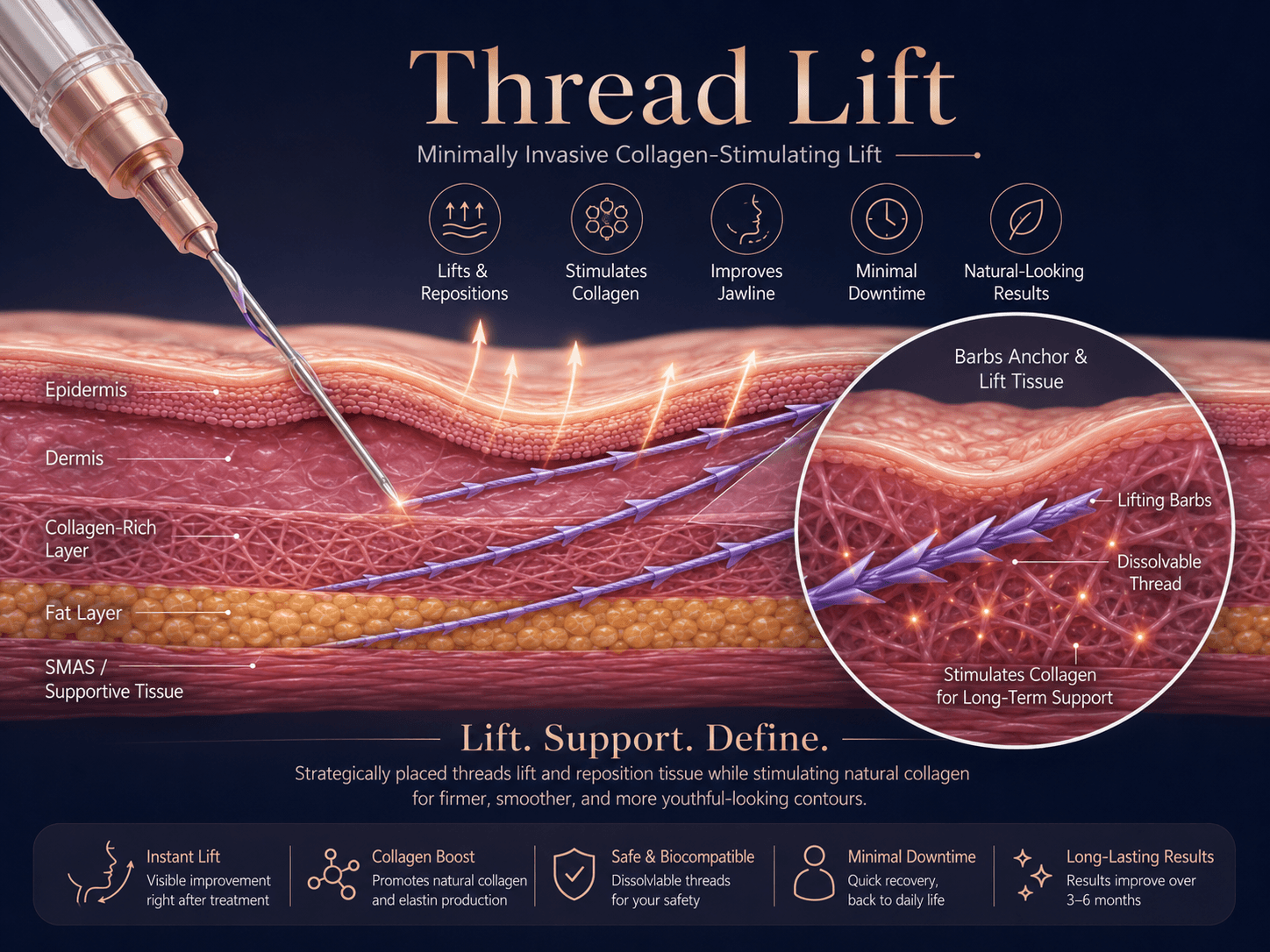
Thread lift is a non-surgical lifting option used for selected sagging concerns. In Korean clinics, it may be recommended for lower-face sagging, jawline support, cheek repositioning, or facial contour improvement. Compared with device lifting, thread lift can create a more direct lifting effect, but it also has more visible recovery considerations. Doctor experience, thread type, thread number, and facial anatomy are especially important.
Best for
- Lower-face sagging
- Jawline support
- Cheek repositioning
- Non-surgical facial lifting
- Patients wanting more visible lift than devices
Not ideal for
- Severe skin laxity requiring surgery
- Very thin skin
- Patients avoiding swelling or bruising
- Unrealistic lifting expectations
- Active infection or poor healing condition
Benefits
Downtime
Swelling, bruising, dimpling, tightness, tenderness, asymmetry, or discomfort may occur. Recovery varies more than with simple device treatments.
Session plan
Thread lift is usually performed as one procedure, with maintenance depending on thread type, facial movement, aging, and individual response.
Before booking
- Ask thread type and number.
- Confirm doctor experience with thread lifting.
- Discuss asymmetry, dimpling, and recovery risks.
- Ask how long swelling may last.
- Avoid booking right before travel photos or events.
- Ask whether device lifting would be safer for your concern.
FAQ
Is thread lift permanent?
No. Results are temporary and vary by thread type, technique, and individual response.
Is thread lift better than Ultherapy?
Thread lift and Ultherapy work differently. Threads may provide more direct repositioning, while Ultherapy is a device-based tightening treatment.
Can thread lift look unnatural?
It can if overdone or poorly planned. Facial anatomy and doctor technique are important.